Forty-five minutes southwest of downtown Houston, wild alligators bask along lake banks by day, and by night, one of the largest telescopes routinely open to the public in the entire United States turns toward the same dark sky. Brazos Bend State Park pairs these two things in a way almost no other Texas park does: a genuine wildlife sanctuary with over 300 alligators and 300-plus bird species, paired with the George Observatory’s 36-inch research-grade telescope. A handful of scheduled closures and event dates are worth knowing before you plan a 2026 trip, though, since this park does shut down entirely on a few specific dates each year.
Here’s what to expect, from alligator safety basics to booking a stargazing session.
Brazos Bend State Park Overview
| Detail | Information |
| Location | 21901 FM 762, Needville, TX 77461 |
| Distance from Houston | About 45 miles / 45 minutes southwest |
| Park size | 4,897 acres |
| Gate hours | 8 a.m. to 10 p.m. daily |
| Day-use fee | $7 per person, ages 13+; 12 and under free |
| Trail mileage | Over 37 miles |
| Alligator population | More than 300 adult alligators |
| Bird species documented | Over 300 |
| George Observatory | Separate admission required; not included with park entry |
| Main telescope | 36-inch Gueymard Research Telescope |
| Swimming/boating | Not permitted anywhere in the park due to alligators |
| 2026 full park closures | Nov. 17–19 and Dec. 15–17 |
Alligators: What to Actually Expect and How to Stay Safe
This is the park’s defining feature, and it’s genuinely different from seeing alligators at a managed exhibit. Brazos Bend hosts more than 300 adult alligators living freely throughout its lakes, creeks, and marshland, and encountering one sunning itself along a trail is a real possibility rather than a rare event. The standard safety guidance is to maintain at least a 30-foot distance from any alligator you encounter; while they’re generally passive and won’t approach unprovoked, they can move with surprising speed if they feel threatened or cornered.
Because of this wild alligator population, swimming and boating are prohibited throughout the entire park, no exceptions. If you’re bringing a dog, keep it leashed at all times (six feet maximum) and never let it drink from or wade into any lake or creek, both for its own safety and because approaching wildlife near water sources creates risk for everyone nearby.
The George Observatory: A Separate Ticket, A Different World
One detail that trips up first-time visitors: entry to Brazos Bend State Park does not include admission to the George Observatory, operated independently by the Houston Museum of Natural Science within the park’s boundaries. If a stargazing session is part of your plan, you’ll need to purchase observatory tickets separately through the Houston Museum of Natural Science website in advance, since tickets aren’t sold at the park headquarters or at the observatory itself.
Saturday night public sessions are the observatory’s signature offering, giving visitors access to the massive 36-inch Gueymard Research Telescope, equipment typically reserved for academic research rather than public use. For 2026 specifically, special “Starry Night VIP” events are scheduled for April 17 and May 8, offering extended viewing windows and expert-led tours of visible deep-sky objects. Given the popularity of these sessions, booking well ahead rather than assuming same-day availability is the safer approach.
Trails: What’s Accessible and What’s Currently Closed
With over 37 miles of trails winding through coastal prairie and moss-draped swampland, Brazos Bend offers routes for a wide range of ability levels. The Creekfield Lake Nature Trail stands out specifically for accessibility: it’s a fully paved, half-mile ADA-accessible loop featuring interactive and tactile exhibits designed for visitors with visual or mobility impairments, making it one of the more genuinely inclusive trail experiences in the Texas state park system.
That said, portions of this same trail have scheduled maintenance closures throughout 2026, including a stretch in May and another window in late July, so if the Creekfield Lake Trail specifically is central to your visit, check current closure dates before you go. Beyond scheduled maintenance, many of the park’s other trails are subject to frequent, less predictable closures due to rain, since the low-lying, swampy terrain floods easily after significant precipitation. Calling the park office ahead of a visit, especially after recent rain, is worth the few minutes it takes to avoid arriving to a closed trail network.
Dates the Park Is Completely Closed
Unlike many state parks that stay open daily year-round, Brazos Bend closes entirely on specific dates each year, and 2026 includes two such windows: November 17 through 19, and December 15 through 17. If your trip planning happens to fall near either of these dates, double-check current park status before finalizing travel arrangements, since arriving to a fully closed gate on either window would waste an otherwise avoidable trip. Additionally, the group camp area and pavilion close October 24 through 25 specifically for a scheduled hunting period, during which only permitted hunters are allowed in that section of the park.
Planning Around the Brazos Bend 50 and Other Events
If you’re a hiker or trail runner rather than a spectator, know that the Brazos Bend 50 running event takes place April 11, 2026, and brings noticeably higher trail activity along with limited parking availability that day. Day entrance remains available on a first-come, first-served basis during the event, but if a quieter, less crowded hiking experience is your goal, this specific date is worth avoiding.
Beyond the running event, the park runs a robust calendar of ranger-led programs throughout the year, covering everything from guided birding hikes to sessions specifically focused on alligator biology and ecology. These programs are typically free with park admission and offer a genuinely deeper look at the park’s wildlife than a self-guided visit alone would provide, so checking the current event calendar before your trip can add real value to a day at the park.
Fishing and Other Activities Beyond Wildlife Viewing
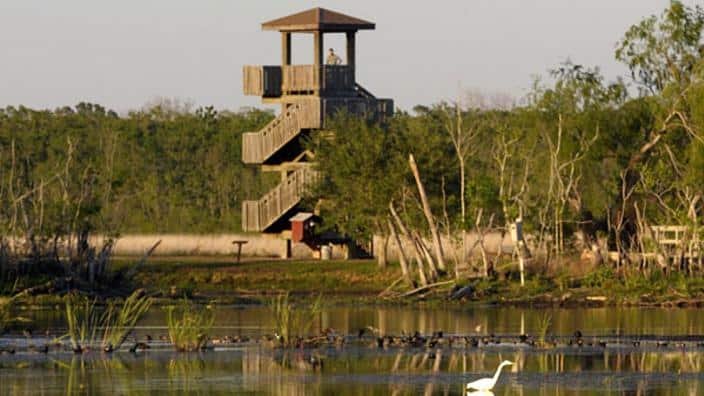
Fishing is a popular and accessible activity here, and unlike many locations, no fishing license is required when casting from the shore or a pier within a Texas state park, making it an easy option for visitors of any age or experience level. Combined with the extensive trail network suited to hiking, biking, and horseback riding, plus the nature center and wildlife observation deck, Brazos Bend offers enough variety that a full day here rarely feels repetitive, even without factoring in the separate observatory experience.
Frequently Asked Questions
Q1. Do I need to buy separate tickets for the George Observatory, or is it included with park entry?
Separate tickets are required. Observatory admission, including the popular Saturday night stargazing sessions, must be purchased in advance through the Houston Museum of Natural Science website and isn’t sold at the park itself or bundled with your park entrance fee.
Q2. Is it safe to hike here given the alligator population?
Yes, with sensible precautions. Keep at least 30 feet of distance from any alligator you see, stay on marked trails, and never let pets or children approach the water’s edge unsupervised. Alligators at Brazos Bend are generally passive when left undisturbed, but they are wild animals, not a managed exhibit.
Q3. What should I do if I planned a trip during one of the park’s full closure dates?
Check current park status well before your visit, since Brazos Bend closes entirely November 17–19 and December 15–17 in 2026. If your dates overlap with a closure, reschedule your visit rather than risking a wasted trip to a locked gate.
Q4. Can I fish without a license if I’m just visiting for the day?
Yes. Fishing from the shore or a pier within Brazos Bend State Park doesn’t require a Texas fishing license, making it one of the more accessible activities here regardless of your experience level or how long you’re staying.