Twenty-five miles southwest of downtown Denver, a 1,355-acre reservoir sits at the foothills of the Rockies, drawing sailboats, jet skis, and paddleboards on any given summer weekend without requiring anyone to actually drive into the mountains. Chatfield State Park is Colorado’s answer to an urban lake escape, built originally not for recreation at all, but to stop the kind of catastrophic flooding that killed 25 people along the South Platte River in 1965.
Here’s what to know before planning a 2026 visit: what it costs, the numbers behind its reservoir and trail system, and the flood-control history that shaped the park’s origins.

Chatfield State Park Overview
| Category | Details |
| Location | Douglas/Jefferson counties, near Littleton, CO |
| Distance from Denver | About 25 miles southwest (30–40 minutes) |
| Total area | About 5,381 acres (park); reservoir surface ~1,355–1,423 acres |
| Established | Dam construction began 1973; opened to public 1975 |
| Daily vehicle pass | $10 |
| Daily individual/walk-in pass | $4 |
| Annual vehicle pass | $80 |
| Keep Colorado Wild add-on (residents) | $29, added to vehicle registration |
| Off-leash dog area | 69 acres, Colorado’s largest; separate $3 daily/$25 annual dog pass required |
| Campsites | 197 developed sites |
| Trail mileage | Over 26 miles (about 12 paved) |
| 2021 visitation | Over 2.1 million visitors |
Where Chatfield State Park Is Located
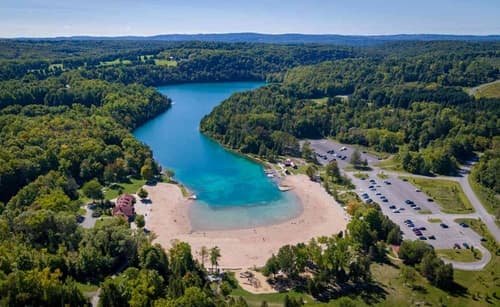
Chatfield State Park sits in Littleton, Colorado, spanning parts of Douglas and Jefferson counties roughly 25 miles southwest of downtown Denver, a drive typically taking 30 to 40 minutes depending on traffic. The park centers on Chatfield Reservoir, fed by the South Platte River and Plum Creek, making it one of the most accessible large-water recreation spots for Front Range residents without a drive into the mountains.
One navigation tip worth knowing before you go: typing “Chatfield State Park” directly into a mapping app can give incorrect directions. Instead, use one of the park’s specific addresses, 9700 S Wadsworth Blvd, Littleton, or 11500 N Roxborough Park Rd, Littleton, depending on which entrance you’re targeting.
What It Costs to Visit in 2026
A standard daily vehicle pass costs $10, while visitors arriving on foot or bicycle pay $4 per person. Frequent visitors can pick up the $80 annual vehicle pass, which covers entry across Colorado’s full state park system, not just Chatfield. Colorado residents also have the option to add a Keep Colorado Wild pass for $29 directly onto their vehicle registration, which functions as an alternative annual park pass built into your license plate renewal.
Camping requires a separate fee on top of the standard daily park pass, and reservations open six months in advance through cpwshop.com or by phone; summer weekends book up quickly given the park’s proximity to such a large metro population. If you’re bringing a dog to the off-leash area, budget for a separate dog pass too, $3 daily or $25 annually, required in addition to your standard vehicle or individual pass.
Facts That Make Chatfield a Denver-Area Standout
Chatfield holds Colorado’s largest off-leash dog area at 69 acres, complete with swimming access for dogs, a genuine rarity among state parks and a major draw for Front Range dog owners. The reservoir itself spans roughly 1,355 to 1,423 acres and supports powerboats, water skiing, sailing, and jet skiing, with all boats required to undergo an Aquatic Nuisance Species inspection before launching to prevent invasive species from spreading between Colorado waterways.
More than 26 miles of trails wind through cottonwood groves, prairie grasslands, and shoreline, with about 12 miles paved and mostly ADA-accessible, serving hikers, cyclists, and equestrians alike, since roughly 24 miles of trail are open to horseback riding through outfitters like Chatfield Stables. The park also completed a major infrastructure project between 2017 and 2020, the $171 million Chatfield Reservoir Reallocation Project, which added 20,600 acre-feet of additional water storage and raised the lake’s level by about 12 feet, requiring some park facilities to be relocated further from the new higher shoreline.
The History Behind Chatfield State Park
Chatfield Reservoir exists because of catastrophic flooding. In June 1965, severe flooding along Plum Creek and the South Platte River killed 25 people, injured 327 more, and caused millions of dollars in damage across the Denver area. In response, the U.S. Army Corps of Engineers began constructing a dam and flood-control reservoir on the South Platte starting in 1973, with the surrounding recreational park opening to the public in 1975.
The reservoir’s name honors a Littleton water works figure who spent 25 years overseeing the layering of pipes and construction of the city’s early water infrastructure, building a system that by the time of his death in 1924 rivaled Denver Water’s own system for quality and access. Today, Chatfield Reservoir continues serving a dual purpose that traces directly back to its origins: flood protection for the surrounding communities and a critical source of drinking water for the region, alongside its now much larger role as one of the busiest recreation destinations in the Colorado state park system.
Frequently Asked Questions
Q1. Why does my GPS give me wrong directions to Chatfield State Park?
Entering “Chatfield State Park” directly into some mapping apps can route you incorrectly. Use one of the specific street addresses instead, 9700 S Wadsworth Blvd or 11500 N Roxborough Park Rd, both in Littleton, to ensure you arrive at the correct entrance.
Q2. Do I need a separate pass for my dog if I want to use the off-leash area?
Yes, the 69-acre off-leash dog area requires its own pass, either $3 for a single day or $25 annually, in addition to your standard vehicle or individual entrance pass. Dogs must stay leashed anywhere outside that designated area.
Q3. How far in advance should I book a campsite for a summer weekend?
Reservations open six months in advance through cpwshop.com or by phone, and summer weekend sites book up quickly given the park’s popularity and proximity to the Denver metro area. Booking as close to that six-month window as possible gives you the best selection.
Q4. Is the annual pass worth it if I mostly just visit Chatfield?
The $80 annual vehicle pass covers entry to every Colorado state park, not just Chatfield, so it pays for itself after about eight visits at the $10 daily rate. Colorado residents might also consider the $29 Keep Colorado Wild plate add-on as a cheaper year-round alternative, depending on their vehicle registration renewal timing.