Show up at a Florida state park in 2026 without checking ahead, and you might get turned away at the gate — a real change from how these parks operated for decades. Four parks now require an online day-use reservation before you can enter at all, part of a broader shift as Florida’s most popular springs and beaches deal with crowds that regularly overwhelmed parking lots and backed traffic onto nearby highways. With more than 175 parks across the state system, fees, reservation rules, and passes vary enough that it’s worth understanding the current landscape before you plan a trip.
Here’s what’s changed for 2026 and how to navigate Florida’s park system without wasting a drive.
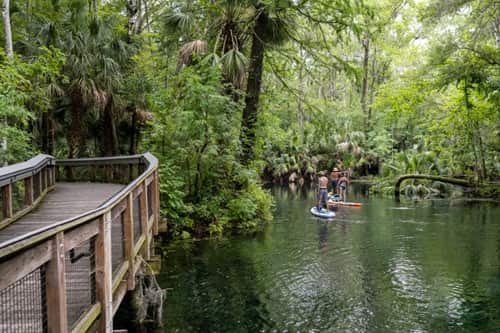
Florida State Parks Overview
| Detail | Information |
| Total parks in the system | Over 175 |
| Standard day-use fee range | Typically $2–$8 per person or per vehicle, depending on park |
| Parks with mandatory day-use reservations | Blue Spring, Wekiwa Springs, Rainbow Springs, Henderson Beach |
| Reservation booking window | Up to 60 days in advance |
| Cost to make a reservation | Free; you pay only the standard admission fee |
| Individual Annual Entrance Pass | Covers the passholder; extra visitors pay $2 each at most parks |
| Family Annual Entrance Pass | Covers up to 8 people entering as a group at most parks |
| Campsite pricing | $16–$42 per night depending on park |
| Cabin pricing | $30–$160 per night depending on park |
| Camping reservation fee | $6.70 nonrefundable, charged once per reservation |
| RV/cabin/yurt utility fee | $7 per night (does not apply to tent camping) |
The New Reservation Requirement: Which Parks and Why
This is the single biggest operational change hitting Florida’s park system in 2026. Blue Spring, Wekiwa Springs, and Rainbow Springs State Parks, along with Henderson Beach State Park on the Panhandle, now require every day-use visitor, including annual passholders, pedestrians, and cyclists, to book an online reservation before arriving. Henderson Beach rolled out its system first, on May 15, 2026, after years of summer traffic backing up onto US-98 outside the park; Blue Spring’s version follows on July 15, 2026.
The mechanics are consistent across all four parks: reservations open 60 days ahead of your visit date, cost nothing extra beyond the standard entry fee, and are made through reserve.floridastateparks.org. Campers are the one exception — a confirmed camping reservation doubles as your entry pass for the dates you’re staying, so campers don’t need a separate day-use booking. If you’re planning to visit any of these four parks, treat the reservation step as mandatory, not optional, since walk-up admission simply isn’t accepted anymore at the gate.
What Happens If You Don’t Have a Reservation
At the affected parks, arriving without a confirmed day-use reservation means you’ll be turned away, full stop — there’s no fallback line to wait in or standby list to join. The reservation itself is refundable if you cancel in advance, which frees up the slot for someone else, but no-shows are non-refundable, so cancel early if your plans change rather than eating the cost.
Pedestrians and bicyclists are the one category who skip the reservation step even at these four parks, though they still pay the standard $2 per-person admission at the gate. If you’re driving, though, plan on booking ahead regardless of which entry category you fall into.
Making Sense of the Annual Pass
For anyone visiting Florida parks more than a handful of times a year, the annual pass system is worth understanding in detail. The Individual Annual Entrance Pass covers one named person, with additional visitors in the same vehicle typically paying $2 each — though a couple of specific parks, including Ellie Schiller Homosassa Springs Wildlife State Park and Weeki Wachee Springs, charge standard admission for extra guests rather than the discounted rate. The Family Annual Entrance Pass extends coverage to a group of up to eight people at most parks, dropping to two people at those same two exception parks.
Passholders ordering online should expect a $6 convenience fee plus $10 shipping per pass, and a temporary digital pass arrives immediately by email, valid for 14 days while the physical card is in transit. It’s worth noting that annual passholders visiting one of the four reservation-required parks still need to book ahead — the pass gets you a discounted or included entry fee, not an exemption from the reservation system itself.
Camping and Cabin Costs Across the System
Overnight stays vary more widely than day-use fees, since campsite pricing ranges from roughly $16 to $42 a night depending on the specific park’s popularity and amenities, and cabins run anywhere from $30 to $160 a night. Every reservation carries a flat $6.70 nonrefundable booking fee regardless of how many nights you’re staying, and RV, cabin, bungalow, and yurt reservations add a $7 nightly utility fee that doesn’t apply to standard tent camping. Stays in Monroe County (the Florida Keys) tack on an additional $2.50 per night county surcharge, a detail easy to miss when budgeting for a Keys trip specifically.
Frequently Asked Questions
Q1. Do I need a reservation to visit any Florida state park, or just these four?
Currently, mandatory day-use reservations only apply at Blue Spring, Wekiwa Springs, Rainbow Springs, and Henderson Beach State Parks. The vast majority of Florida’s 175-plus parks still operate on standard walk-up, pay-at-the-gate admission, though it’s worth checking a specific park’s current alerts before visiting, since more locations could adopt similar systems as capacity issues arise elsewhere.
Q2. Does my annual pass exempt me from the new reservation requirement?
No. Annual passholders still need to book an online day-use reservation at the four affected parks; the pass changes what you pay or how you check in, but it doesn’t bypass the booking step itself.
Q3. What happens if the reservation slots are full for the day I want to visit?
Once a park’s daily capacity is reached, no further reservations are released for that date, similar to how the park previously closed once parking filled up. Booking as early as the 60-day window allows, especially for weekends and holidays, is the best way to avoid missing out.
Q4. Is camping affected by these new day-use reservation rules?
No. A confirmed camping reservation serves as your entry pass for the dates of your stay at all four affected parks, so campers don’t need to make a separate day-use booking on top of their campsite reservation.