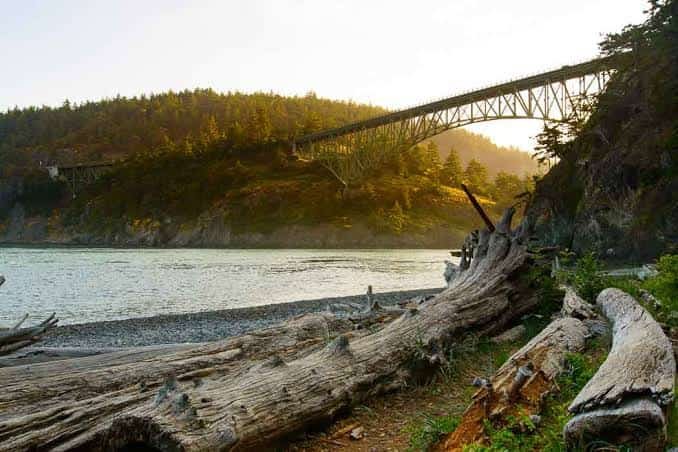
Where the Strait of Juan de Fuca collides with Skagit Bay in a churning, violent narrows, a 1935 steel bridge arches 180 feet above the chaos. Below it, tidal currents can exceed 8 knots, creating standing waves and whirlpools strong enough to have swallowed boats and commanded respect from mariners for generations. Deception Pass is Washington’s most-visited state park, drawing over 3 million visitors annually to a landscape that compresses old-growth forest, saltwater shoreline, and freshwater lakes across two islands into just over 4,000 acres.
Here’s what to know before planning a 2026 visit: what it costs, the numbers behind the famous bridge and tidal narrows, and the Depression-era history that built much of what’s still standing today.
Deception Pass State Park Overview
| Category | Details |
| Location | Fidalgo Island and Whidbey Island, Washington |
| Nearest towns | Oak Harbor (south), Anacortes (north) |
| Total area | 4,134 acres |
| Shoreline | 77,000 feet saltwater; 33,900 feet freshwater (three lakes) |
| Required pass | Discover Pass (no separate per-person entrance fee) |
| Discover Pass, daily | $10 |
| Discover Pass, annual | $45 (as of late 2025) |
| Bridge built | 1935, by the Civilian Conservation Corps |
| Bridge height above water | About 180 feet |
| Tidal current speed | Can exceed 8 knots |
| Annual visitation | Over 3 million — Washington’s most-visited state park |
Where Deception Pass State Park Is Located
Deception Pass State Park straddles the narrow tidal channel separating Fidalgo Island and Whidbey Island in northwestern Washington, roughly between the towns of Oak Harbor to the south and Anacortes to the north, both about 9 miles from the park’s central bridge crossing. The park sits along Highway 20, making it an easy stop for anyone driving between the Seattle area and the San Juan Islands or Anacortes ferry terminal.
Because the park spans two separate islands connected by the historic bridge, visitors get access to genuinely varied terrain within a short drive: old-growth forest and rugged cliffs on one side, calmer beaches and picnic areas on the other, plus three freshwater lakes, Cranberry Lake, Pass Lake, and Heart Lake, offering a gentler alternative to the churning saltwater narrows.
What It Costs to Visit in 2026
Unlike parks that charge a per-person or per-vehicle entrance fee directly, Deception Pass requires a Discover Pass for any vehicle parking within Washington state park lands, a system used across all of Washington’s more than 140 state parks rather than being specific to this one location. A daily Discover Pass costs $10, while the annual pass costs $45 as of the most recent pricing update in late 2025, covering access to over 100 state parks, hundreds of water access points, and thousands of miles of trails statewide.
Passes can be purchased online in advance, at sporting goods retailers, or directly at the park’s automated pay stations, including one at the main Scenic Vista parking area near the bridge. If you’re camping, note that your camping fee covers parking for one vehicle at your specific site, so you don’t need a separate Discover Pass on top of that, though additional vehicles at your site would still require one. Washington also designates several fee-free days throughout the year when the Discover Pass isn’t required, so checking the current year’s schedule before a planned visit can save you the cost entirely.
Facts That Make Deception Pass Extraordinary
The park’s centerpiece, Deception Pass Bridge, was built by the Civilian Conservation Corps in 1935, spans 180 feet above the narrows, and remains listed on the National Register of Historic Places, making it one of the most photographed structures in the entire state. Below the bridge, tidal currents can exceed 8 knots, creating standing waves and whirlpool patterns strong enough to have genuinely endangered small boats over the decades, a dramatic tidal phenomenon that plays out twice daily as water rushes between the strait and the bay.
The islands themselves are built on Jurassic-age metamorphic rock dating back 150 to 200 million years, among the oldest exposed bedrock anywhere in the Puget Sound region, later sculpted further by Pleistocene-era glaciers that carved much of the broader Puget Sound landscape. Rosario Beach’s tide pools rank among the most accessible and biodiverse intertidal areas in the Pacific Northwest, and leashed dogs are welcome throughout most of the park, though they’re not permitted in designated swimming areas or inside park buildings.
The History Behind Deception Pass State Park
Human history at this site stretches back thousands of years, with the Samish and Swinomish peoples living along what’s now Cornet Bay, Bowman Bay, and Rosario well into the early 1900s. The park’s unusual name traces back to British explorer Captain George Vancouver, who initially believed the area was a peninsula before realizing it was actually a separate island; he named that island Whidbey after his assistant Joseph Whidbey, and named the inlet Deception Pass to commemorate his own navigational mistake.
Ferry service across the narrows began as early as 1913, with regular scheduled service starting in 1919 under Berte and Augie Olson, who designed and operated two ferries; Berte became the first woman licensed to skipper a ferry boat on the waters of the Salish Sea. Advocacy for a permanent bridge grew over subsequent years, supported by local farmers, the American Legion, and community picnics at Cranberry Lake meant to build public support for the project. When the Great Depression hit, the federal government sent Civilian Conservation Corps Company 266 to Cornet Bay in June 1933, and CCC enrollees, working in the distinctive native stone-and-timber “parkitecture” style of the era, built trails, roads, kitchen shelters, restrooms, and bathhouses throughout the park while also preparing roadways for the bridge itself, work that included hand-drilling for rock-blasting powder charges. The bridge opened in 1935, and the CCC Interpretive Center at Bowman Bay, housed in a restored 1930s bathhouse, now preserves photographs and memorabilia honoring the “Tree Army” that built much of what remains Washington’s most beloved park.
Frequently Asked Questions
Q1. Do I need a separate entrance fee in addition to the Discover Pass?
No, there’s no separate per-person entrance fee at Deception Pass. The Discover Pass covers vehicle parking anywhere within the park, and that’s the only fee required for a standard day visit.
Q2. If I’m camping, do I still need to buy a Discover Pass separately?
No, your camping fee includes parking for one vehicle at your specific campsite, so a separate Discover Pass isn’t needed for that vehicle. Additional vehicles beyond the one covered by your camping fee would still require their own pass.
Q3. Are there days when I can visit without needing a Discover Pass at all?
Yes, Washington designates several fee-free days throughout the year, including dates in January, March, April, June, August, September, and November, when the Discover Pass requirement is waived statewide. Check the current year’s official schedule before planning around one of these dates.
Q4. Is it safe to swim in the narrows given how strong the tidal currents are?
Swimming directly in the Deception Pass narrows is genuinely dangerous given currents that can exceed 8 knots and create whirlpools capable of endangering boats. The park’s freshwater lakes, Cranberry, Pass, and Heart Lake, offer a much safer alternative for swimming, provided you use a properly fitted life jacket and go with a group.