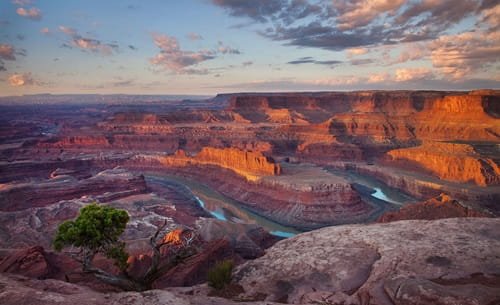
The name comes from a grim 19th-century legend: cowboys once corralled wild mustangs on this narrow mesa top, naturally fenced in by sheer cliffs and a slim neck of land, only for some of the horses to be left behind and die of thirst within sight of the Colorado River 2,000 feet below. Today, that same overlook is one of the most photographed vistas in the world, featured in the closing scene of “Thelma & Louise” and the opening of “Mission: Impossible 2.” Unlike its famous neighbors, Arches and Canyonlands national parks, Dead Horse Point still doesn’t require timed-entry reservations, a genuine advantage for anyone tired of booking national park slots months in advance.
Here’s what to know about fees, camping, and current conditions before a 2026 visit.
Dead Horse Point State Park Overview
| Detail | Information |
| Location | About 32 miles from Moab, UT, via US-191 and SR-313 |
| Elevation | About 5,900–6,000 feet |
| Park hours | 6 a.m. to 10 p.m., year-round |
| Visitor Center hours | Generally 9 a.m.–5 p.m.; closed Thanksgiving, Christmas, New Year’s Day (park itself stays open) |
| Vehicle entrance fee | $20 (up to 8 passengers); $10 motorcycle/pedestrian/cyclist |
| Overlook drop | 2,000 feet to the Colorado River |
| Hiking trails | East Rim Trail (1.5 mi one-way), West Rim Trail (2.5 mi one-way) |
| Mountain biking | Intrepid Trail System, 16.6 miles, moderate to intermediate |
| Camping | Kayenta Campground (21 sites) and Wingate Campground (31 sites, 20 with electric) |
| Yurts | 5 Moenkopi Yurts near the entrance, reservation only |
| Timed entry | Not currently required (unlike nearby national parks) |
Why Your Park Fee Doesn’t Cover Arches or Canyonlands
This is an important distinction for anyone treating Dead Horse Point as a quick add-on to a national park trip. Dead Horse Point is a Utah State Park, not part of the National Park Service, so a National Parks Pass isn’t valid here, and conversely, your $20 Dead Horse Point entrance fee doesn’t grant entry into nearby Canyonlands or Arches National Parks. Budget these as three entirely separate admission fees if you’re visiting all three during the same trip, rather than assuming any overlap in coverage.
A Utah State Parks annual pass is available if Dead Horse Point is one of several Utah state parks on your itinerary, but it similarly won’t cover the adjacent national parks, since these operate under completely different agencies with separate fee structures.
No Timed Entry: A Genuine Advantage Right Now
Unlike Arches National Park, which has implemented timed-entry reservation systems in recent years to manage overwhelming crowds, Dead Horse Point currently operates without any timed-entry requirement. Visitors report showing up even during busy periods like early August without encountering the reservation headaches that increasingly define nearby national park visits. This could change in the future given rising visitation trends across Utah’s parks generally, so this remains a current-conditions advantage rather than a guaranteed permanent feature, but for now, it’s a genuine reason to consider Dead Horse Point over more crowded, reservation-gated alternatives.
The Overlook and Rim Trails
The signature experience here is simply walking to the canyon rim and taking in the 2,000-foot drop to the Colorado River below, with views extending across Canyonlands’ sculpted pinnacles and buttes. Two dedicated hiking trails, where mountain biking isn’t permitted, lead from the visitor center to the Dead Horse Point overlook: the East Rim Trail at 1.5 miles one-way, and the West Rim Trail at 2.5 miles one-way. Both are considered easy walks, making the park’s most dramatic views accessible to a wide range of fitness levels without requiring technical hiking experience.
Leashed dogs are welcome on these hiking trails, a detail worth knowing if you’re traveling with a pet and want to include them in the main overlook experience rather than leaving them behind at camp.
Mountain Biking: The Intrepid Trail System
For visitors wanting more than a scenic overlook stop, the Intrepid Trail System offers 16.6 miles of moderate to intermediate singletrack winding through slickrock domes and desert terrain, bisected by the main park road. While technically milder by Moab’s famously aggressive mountain biking standards, these trails remain a genuine draw for riders of varying skill levels, and mountain and e-bike rentals are available within the park by reservation through a local outfitter.
One rule worth knowing if you’re bringing a dog along for a biking day: dogs are not permitted on the mountain bike trails, only on the dedicated hiking routes, so plan your pet’s participation around the East and West Rim Trails specifically rather than the Intrepid system.
Camping and Yurts: Booking and Practical Limitations
Dead Horse Point offers two developed campgrounds. Kayenta Campground provides 21 sites nestled in a juniper grove, each with a shade structure, picnic table, fire ring, and RV electrical hookup; four sites are non-reservable and one is ADA accessible. Wingate Campground, added more recently, sits atop the mesa with 31 sites, 20 of which include electrical hookups, offering far-reaching views across the surrounding mountain ranges and canyons.
For a different kind of overnight stay, five Moenkopi Yurts near the park entrance come furnished with bunk beds, a futon, tables, and AC/heating units, though smoking and cooking inside are prohibited, and up to two dogs are permitted inside for a separate pet fee (no other pets allowed). Know before you book: there are no shower facilities anywhere in the park, with the nearest available in Moab, roughly 35 miles away, and no water hookups at any campsite, so fill your storage tanks and containers before arriving. There are also no EV charging stations for yurt occupants, and extension cords aren’t permitted; fast charging is available instead at Lions Park in Moab.
Checking Current Fire Restrictions
Given the surrounding high desert environment, fire bans are periodically enacted in and around Moab during dry conditions, and when active, they prohibit lighting any fires or personal fireworks, including in your campsite’s fire ring. Check current fire restriction status before your trip, particularly if a campfire is part of your planned camping experience, since these bans can be enacted with relatively short notice during dry stretches.
Frequently Asked Questions
Q1. Does my Dead Horse Point entrance fee get me into Arches or Canyonlands too?
No. Dead Horse Point is a Utah State Park with its own separate fee structure. A National Parks Pass isn’t accepted here, and your Dead Horse Point admission doesn’t cover entry to the nearby national parks, which require their own separate tickets or passes.
Q2. Do I need a timed-entry reservation to visit, like at Arches?
Not currently. Dead Horse Point doesn’t operate a timed-entry system as of now, a genuine advantage over increasingly crowd-managed national parks nearby. This could change as visitation grows, so check current park conditions if you’re planning far ahead.
Q3. Can I bring my dog on both the hiking trails and mountain bike trails?
Dogs are welcome on the East and West Rim hiking trails but are not permitted on the Intrepid Trail System’s mountain biking routes. Plan pet-inclusive activities around the hiking trails specifically.
Q4. Are there showers available at the campgrounds?
No. There are no shower facilities anywhere in the park; the nearest options are in Moab, about 35 miles away. Campers should also fill water containers before arriving, since no water hookups are available at any campsite.