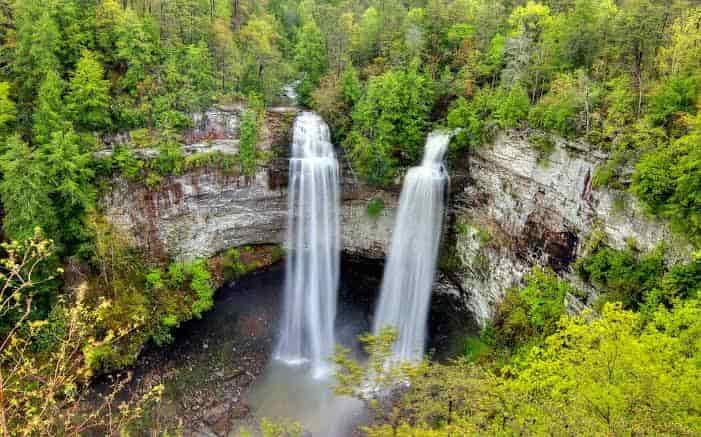
At 256 feet, Fall Creek Falls drops further than almost any other waterfall east of the Rocky Mountains, plunging into a shaded gorge pool on Tennessee’s Cumberland Plateau. It’s the anchor of a genuinely massive park, nearly 29,800 acres with a lodge, golf course, multiple campgrounds, and six named waterfalls beyond the namesake fall itself. Located roughly an hour from Chattanooga and under two hours from both Nashville and Knoxville, it’s become one of the most visited state parks in the Southeast, and there’s enough packed into it that a single day rarely covers everything.
Here’s what to know about fees, current trail status, and lodging options before a 2026 visit.
Fall Creek Falls State Park Overview
| Detail | Information |
| Location | Near Spencer, TN, on the Cumberland Plateau |
| Park size | About 29,800 acres |
| Distance from Chattanooga | About 1 hour |
| Distance from Nashville/Knoxville | Under 2 hours |
| Park hours | Open 24 hours; road to the falls locks at dark |
| Day-use areas | Close at sunset |
| Parking fee | $5 per vehicle per day; annual passes available |
| Main waterfall height | 256 feet — one of the tallest east of the Rockies |
| Other named waterfalls | Piney Falls, Cane Creek Falls, Cane Creek Cascades, plus additional falls ranging 8–256 feet |
| Lodging | The Lodge at Fall Creek Falls, 30 “Fishermen Cabins” on the lake, 20 two-bedroom cabins |
| Current trail note | Millikan’s Overlook Trail closed (overlook itself remains open) |
| Camping check-in/out | 4 p.m. / 12 p.m. |
Getting Oriented: Why You Need a Map Here
This isn’t an exaggeration for effect — Fall Creek Falls genuinely is too large to navigate by guesswork. With a golf course, visitor center, nature center, cabins, a pool, a lake, multiple campgrounds, a scenic driving route, and a full-service lodge all spread across nearly 30,000 acres, first-time visitors consistently recommend grabbing a park map, either on your phone or in paper form, before setting out. The Nature Center, near the park’s north entrance, makes a logical first stop, both for trail information and as a starting point for several connecting trails.
A popular combination route links the Fall Creek Falls overlook, the Nature Center’s woodland trail, and the separate Overlook Trail into one cohesive outing, giving visitors a genuine sense of the park’s range without requiring an entire day dedicated to a single trail.
What’s Currently Closed: Millikan’s Overlook Trail
As of the latest park updates, Millikan’s Overlook Trail itself is closed, though the overlook it leads to remains accessible. This is worth flagging specifically because it’s an easy detail to miss when planning a hike, arriving expecting to walk the full trail only to find the trail closed while the destination view is still reachable by another route. Trail conditions and closures can shift throughout the year at a park this large, so checking current status through the park’s official channels before setting out on a specific route is a smart habit rather than an unnecessary extra step.
The Falls: What Makes Each One Distinct
Fall Creek Falls itself, the park’s namesake and headline attraction, drops 256 feet into a shaded pool, a height that puts it among the tallest waterfalls in the entire eastern United States. But it’s far from the only cascade worth seeing here. Piney Falls, Cane Creek Falls, and Cane Creek Cascades round out the park’s signature named waterfalls, with heights ranging from as little as 8 feet up to the main fall’s dramatic 256, and the park counts dozens of additional smaller falls scattered throughout its backcountry for visitors willing to hike further off the main trail network.
Given the range in height and accessibility across these falls, it’s worth deciding ahead of time whether you’re chasing the dramatic main event or interested in a broader waterfall-hopping day covering several smaller, quieter cascades.
Accessibility: What’s Available for Visitors With Mobility Needs
Fall Creek Falls has made a genuine effort to accommodate visitors who can’t manage steep or uneven trails. The park offers accessible parking, restrooms, and trails, along with all-terrain wheelchairs and adult changing tables, features not universally available at large state parks with this much rugged gorge terrain. The Fall Creek Falls Overlook Trail specifically is designed to be accessible to persons with disabilities, and the Nature Center and scenic driving route both offer ways to experience much of the park’s landscape without requiring a strenuous hike.
If accessibility is a specific concern for your group, calling ahead to confirm current equipment availability and trail conditions is worth doing, since conditions and equipment access can shift seasonally.
Choosing Your Lodging: Lodge, Fishermen Cabins, or Standard Cabins
Overnight options here split into a few genuinely distinct categories. The Lodge at Fall Creek Falls is a modern hotel property within the park, suited to visitors wanting standard hotel comfort and an on-site restaurant. For a different experience, 30 “Fishermen Cabins” sit directly on Fall Creek Lake, with ten of them built as two-story units featuring a full kitchen, dining area, living room, and half bath on the lower floor, an appealing option for anyone prioritizing direct lake access.
Beyond these, the park also offers 20 standard two-bedroom cabins that can sleep up to eight guests. Pet owners should note that select cabins are pet-friendly, welcoming well-mannered pets for a $20 per-pet, per-night fee, though this policy varies by specific cabin, so confirm pet eligibility for your chosen unit before booking rather than assuming all cabins accommodate animals.
Camping Rules Worth Knowing Before You Book
The Main Campground splits into five distinct areas (A through E), all offering tables, grills, water, and a mix of 50, 30, and 20-amp electric hookups, with 107 sites specifically offering sewer connections for full-hookup convenience. Check-in runs from 4 p.m. with checkout at noon, and quiet hours across all campgrounds run from 10 p.m. to 6 a.m.
A few rules are strictly enforced here: absolutely no hiking after dark, camping only within designated campgrounds with no exceptions, and no off-trail hiking or shortcutting, since all trails are clearly marked with white or blue blazes. Campsites are capped at one motor home, fifth-wheel, or travel trailer plus one tent (or two tents without a wheeled unit), with standard rates covering up to six people per site; larger groups need to reserve additional sites rather than exceeding that limit on one.
Frequently Asked Questions
Q1. Is there an entrance fee to visit Fall Creek Falls State Park?
No general entrance fee applies, but parking runs $5 per vehicle per day, with annual passes available if you’re planning multiple visits throughout the year.
Q2. Can I hike to see the waterfalls after dark?
No, hiking after dark is strictly prohibited throughout the park, and the road leading to the main falls locks at dark specifically to prevent this. All day-use areas close at sunset, so plan your waterfall visits to wrap up before then.
Q3. Are the Fishermen Cabins pet-friendly, or only certain cabins?
Pet policies vary by specific cabin rather than applying uniformly across the whole property. Some cabins welcome well-mannered pets for a $20 per-pet, per-night fee, so confirm your specific cabin’s pet policy directly when booking rather than assuming.
Q4. Is Millikan’s Overlook still visible if the trail leading to it is closed?
Yes. While the Millikan’s Overlook Trail itself is currently closed, the overlook remains accessible, typically via an alternate route. Check current park trail maps or ask at the visitor center for the best current path to reach it.