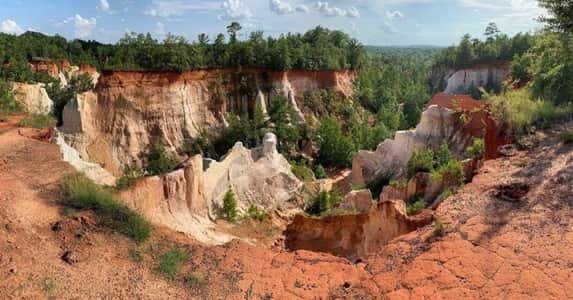
Georgia’s “Little Grand Canyon” is barely a century old, and humans built it entirely by accident. Poor 19th-century farming practices stripped away protective vegetation across this stretch of southwest Georgia, and the resulting erosion carved gullies up to 150 feet deep into soft, ancient clay, exposing vivid bands of pink, orange, red, and purple that now rank Providence Canyon among Georgia’s Seven Natural Wonders. It’s a rare case of environmental damage accidentally producing something genuinely spectacular, and the park built around it offers a surprisingly full day of hiking without demanding an extended commitment.
Here’s what to know about park hours, trail options, and camping before your 2026 visit.
Providence Canyon State Park Overview
| Detail | Information |
| Location | Near Lumpkin, GA, about 28 miles southwest of Plains |
| Park size | About 1,003 acres |
| Canyon depth | Up to 150 feet |
| Park hours (Sept. 15–April 14) | 7 a.m.–6 p.m. |
| Park hours (April 15–Sept. 14) | 7 a.m.–9 p.m. |
| Visitor Center hours | 8 a.m.–5 p.m. |
| Parking/entry fee | Required; roughly $10/day; annual passes available |
| Signature trails | White Blaze Canyon Loop (~3–5 miles); Perimeter/Rim Trail (~2–3 miles) |
| Number of accessible canyons | 9, reached from the canyon floor |
| Camping | Primitive only — 6 backcountry sites, 3 pioneer sites |
| Camping fees | $3.75–$70 per night depending on site type |
| Rare wildflower | Endangered Plumleaf Azalea, blooming July–August |
Why This Canyon Is Barely 100 Years Old
Understanding Providence Canyon’s origin genuinely changes how you experience it. Unlike the Grand Canyon or Bryce Canyon, formed over millions of years, these gullies began forming in the 1800s when agricultural clearing exposed the region’s soft, erosion-prone soils to rainfall and runoff. What was originally a land-management failure has, over roughly a century, produced a landscape striking enough to earn a spot among Georgia’s official Seven Natural Wonders. The visitor center covers this history in detail, and it genuinely enriches a visit to know you’re looking at accidental geology rather than an ancient formation.
Choosing Your Trail: Canyon Floor vs. Rim
Providence Canyon offers two genuinely different ways to experience the landscape, and combining both makes for a satisfying half-day visit. From the canyon floor, accessible via an easy walk down from the main parking lot, visitors can reach nine distinct canyons, following sandy creek beds that often carry a shallow trickle of water. Expect your shoes to get wet and muddy here; water-resistant footwear is genuinely worth packing rather than optional, since the creek-bed walking is part of the experience rather than an occasional inconvenience.
For a different perspective, the Rim Trail (sometimes called the Perimeter Loop) runs roughly two to three miles along the canyon’s edge, delivering sweeping views down into the gullies from above rather than walking through them. Many visitors combine a canyon floor walk with a portion of the rim trail, and the full White Blaze Canyon Loop, when combined with in-canyon walking, can stretch to about five miles total. Most visitors report needing around three hours to see the highlights without rushing, making this a genuinely manageable day-trip destination rather than a multi-day commitment.
The Plumleaf Azalea: A Rare Summer Bloom
If you’re visiting in July or August specifically, keep an eye out for the endangered Plumleaf Azalea, one of the few places on Earth where this particular wildflower grows naturally. Its bloom window is genuinely narrow and seasonal, so if seeing this rare plant is part of your visit’s appeal, plan your trip for mid-summer rather than the cooler spring or fall months that otherwise offer more comfortable hiking temperatures.
Weather and Best Visiting Season
Spring generally offers the most comfortable hiking conditions here, with daytime highs running from the mid-50s to mid-70s Fahrenheit, a real advantage in a region where summer heat can make canyon-floor hiking genuinely uncomfortable. Trails, particularly the creek-bed sections on the canyon floor, can turn muddy after rain regardless of season, so check recent weather before committing to a specific trail plan, and always pack more water than you think you’ll need if visiting during warmer months.
Camping: Backcountry Only, No RV or Tent Sites
This is worth knowing clearly before planning an overnight stay, since it differs from many state parks with developed campgrounds. Providence Canyon offers no traditional RV or tent camping; instead, it maintains six backcountry campsites and three pioneer sites, all reached via the park’s backcountry trail winding through mixed forest and highlighting portions of the canyon. Fees range from $3.75 to $70 per night depending on the specific site type, considerably cheaper at the primitive end than a standard developed campground elsewhere.
If you’re hoping for a more traditional camping or cabin experience nearby, Florence Marina State Park sits just nine miles away on the 45,000-acre Lake Walter F. George, offering camping, cottages, and efficiency units as a practical overnight alternative if Providence Canyon’s backcountry-only options don’t fit your trip.
Understanding the Overnight Vehicle Fee Policy
If you’re camping at one of the backcountry or pioneer sites, know that overnight guests pay the daily ParkPass fee only once per vehicle for the entire duration of their stay, regardless of how many nights you’re camping. Parking itself is not automatically included with your camping reservation, so budget for this fee separately when planning your overnight trip’s total cost.
Frequently Asked Questions
Q1. Can I camp in an RV or tent at Providence Canyon?
No. The park offers only primitive backcountry camping, six backcountry sites and three pioneer sites, reached via the backcountry trail. There’s no developed campground for RVs or standard tent camping within the park itself.
Q2. When is the best time to see the Plumleaf Azalea in bloom?
July and August specifically, since this endangered wildflower has a narrow summer bloom window and Providence Canyon is one of the few places on Earth where it grows naturally.
Q3. Do I need to hike both the canyon floor trails and the rim trail, or is one enough?
Either can be done independently, but combining them gives the fullest experience: the canyon floor lets you walk directly among the colorful gully walls, while the rim trail offers sweeping overhead views. Most visitors budget around three hours to combine both without rushing.
Q4. Are the canyon floor trails suitable for regular sneakers, or do I need special footwear?
Water-resistant footwear is genuinely recommended rather than optional. The canyon floor trails follow sandy creek beds that often carry shallow water, and your shoes will likely get wet and muddy as part of the standard hiking experience.